
Cherokee County Arrest Records and Court Charges
Cherokee County arrest records are created by law-enforcement and jail processes. The Sheriff's Office is the county law-enforcement and detention channel, led by Sheriff Jeff Shaver. The official sheriff site lists the Sheriff's Office and Detention Center at 110 Cedar Bluff Road, Centre, AL 35960, with the sheriff phone at 256-927-3365, dispatch at 256-927-3939, and detention at (256) 927-6435. A booking or arrest record may show the arresting agency, booking date, charge text, and current custody status, but it is not the final court outcome.
Court charges after arrest are different. The Ninth Judicial Circuit District Attorney serves Cherokee and DeKalb Counties and presents criminal cases in court after working with law enforcement. Once a case exists in Circuit Court or District Court, the Circuit Clerk's court record becomes the source for charge status, plea, disposition, sentence, and certified copies. The custody and roster side is handled through the Cherokee County inmate records channel, while the complete court file and final outcome are handled through Cherokee County criminal court records.
Cherokee County Arrest Records Search
A practical arrest-to-charge search uses more than one official channel. Start with the sheriff roster if the question is current custody, recent release, booking number, booking charge, or bail status. Move to Alacourt ACCESS / Just One Look or the Circuit Clerk records request form when the question is the filed court charge, case number, disposition, sentence, or certified copy. If the charge started from a warrant, the magistrate and sheriff process may also matter.
- Check the official sheriff roster for a current inmate or 48-hour release record when custody is the first question.
- Use the booking name, booking number, arresting agency, and charge text to help match a later court case.
- Search Alacourt by defendant name or case number after the case is filed in Cherokee County court.
- Read each charge separately, including amendments, dismissal entries, plea entries, and final disposition.
- Request certified copies from the Circuit Clerk when an official court document is needed.
There is no official local source in the reviewed research that combines every Cherokee County arrest record, active warrant, jail booking, and court charge into one free public database. ADOC, BOP, VINE, and Alacourt serve different purposes. ADOC is for state prison custody. BOP is for federal custody. VINE provides custody notification. Alacourt and the Circuit Clerk are the court charge and docket path.
Cherokee County Charges After Arrest
After an arrest, the charge record can begin through a complaint, information, or indictment, depending on the case and stage. A complaint may be tied to an officer, warrant, or prosecutor filing. An indictment is a grand jury charging document, most often tied to felony prosecution. The research did not locate a local public defender office page, so defense appointment questions should be directed to the court handling the case, the judge at an appearance, or the Circuit Clerk for procedure rather than a made-up office.
| Complaint | Information | Indictment | |
|---|---|---|---|
| Filed by | Officer, complainant path, or prosecutor depending on the matter. | Prosecutor when allowed by procedure. | Grand jury after felony review. |
| Common use | Misdemeanors, warrants, traffic-related charges, or initial filings. | Formal prosecutor-filed charge where procedure permits. | Felony prosecution and grand jury action. |
| Record source | May appear in the court file and related warrant materials. | Appears in the court case after filing. | Appears in Circuit Court felony records. |
| What to verify | Case number, charge text, arresting agency, and court. | Charge count, status, plea, and disposition. | Indictment count, arraignment, plea, trial, or sentence. |
The official Sheriff's FAQ is one source for practical report and warrant routing.
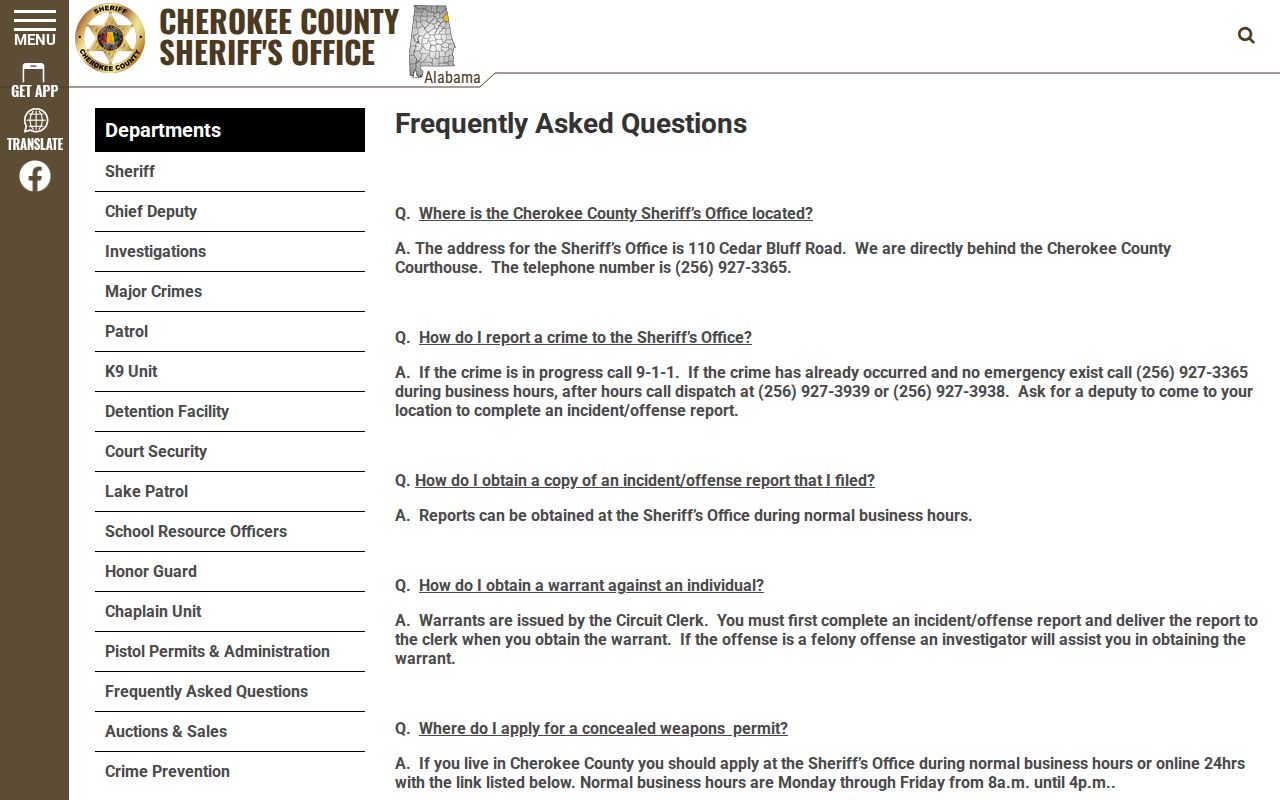
That sheriff-side routing helps explain why a person may need both an incident report and a court charge record.
Cherokee County Charge Status Terms
Charge status can change after booking. The roster may list the charge known at intake, but the court record may later show a different charge, a reduced count, a dismissed count, a grand jury indictment, or a plea to one count while others are dismissed. Cherokee detention profile language warns that charges and bail may change after court appearances and that detention staff should be contacted for current bail amount, charges, and case numbers.
| Status | What It Means |
|---|---|
| Pending | The charge is active and has not reached final disposition. |
| Amended | The charge text, count, or level changed after filing. |
| Reduced | The filed charge was lowered to a lesser charge or level. |
| Dismissed | The court record shows the charge was ended without conviction on that count. |
| Nolle prosequi | The prosecutor declined to pursue the charge further in that case posture. |
| Disposed | The court has entered a result for the charge or case. |
Charge abbreviations also need care. The detention page identifies examples such as FTA for failure to appear, FTP for failure to pay, DUI for driving under the influence, GJI for grand jury indictment, and drug/property abbreviations used by the jail. Those abbreviations should be confirmed against the court docket before treating them as final case outcomes.
Cherokee County Charges vs Convictions
Being arrested or charged in Cherokee County is not the same as being convicted. A charge is the accusation carried into the justice system. A conviction is the court result after the legal process supports guilt. The distinction matters because a single arrest can produce several booking charges, and a later court case can dismiss some counts, amend others, or end with a plea to a different count.
| Charge | Conviction | |
|---|---|---|
| Meaning | Accusation filed or carried from arrest into court. | Final guilt result from plea, verdict, or qualifying court action. |
| Where found | Booking record, warrant record, complaint, indictment, or docket. | Disposition, judgment, sentence, and financial entries. |
| Can change | Yes, charges may be added, reduced, amended, or dismissed. | Usually changed only through appeal, post-judgment order, or relief. |
| Best check | Current court docket and charge status. | Final disposition and sentence for each count. |
Cherokee County Sealed vs Expunged Charges
Some arrest and charge records are restricted from ordinary public access. Juvenile court records are confidential under Alabama law. Sealed records are hidden from normal public access by law or court order. Expunged records are removed from ordinary public access after a court grants relief under Alabama's expungement law. ALEA states that Alabama courts grant expungements, not ALEA.
| Sealed | Expunged | |
|---|---|---|
| Visibility | Blocked from ordinary public inspection. | Removed from normal public lookup after a granted petition. |
| Source | Statute, court order, or confidentiality rule. | Code of Alabama Section 15-27 and related court process. |
| Common examples | Juvenile, sensitive, or court-restricted matters. | Eligible misdemeanor, traffic, violation, municipal, or qualifying criminal charges. |
| Where to ask | The court or clerk for the case. | The criminal division of Circuit Court where charges were filed. |
Cherokee County Charge Codes and Levels
Charge text may be short in the roster and more formal in the court record. District Court handles misdemeanor matters, traffic cases, and preliminary felony stages. Circuit Court handles felony level criminal cases and other general jurisdiction trial work. A warrant origin case may start with a probable cause review by a magistrate, while a felony case can later be presented to a grand jury. One arrest can lead to several counts, and each count should be reviewed separately.
Local venue matters. The Cherokee warrant page says county magistrate jurisdiction covers misdemeanor offenses outside Centre city limits and Cedar Bluff town limits, felonies occurring in Cherokee County, certain traffic offenses written by state troopers, county deputies, and Leesburg police officers, and worthless checks received in Cherokee County. Misdemeanors inside Centre or Cedar Bluff ordinarily go through municipal court unless a felony or extraordinary circumstance is involved.
The Sheriff's contact page is one official source for the law-enforcement channel tied to reports and charge follow-up.
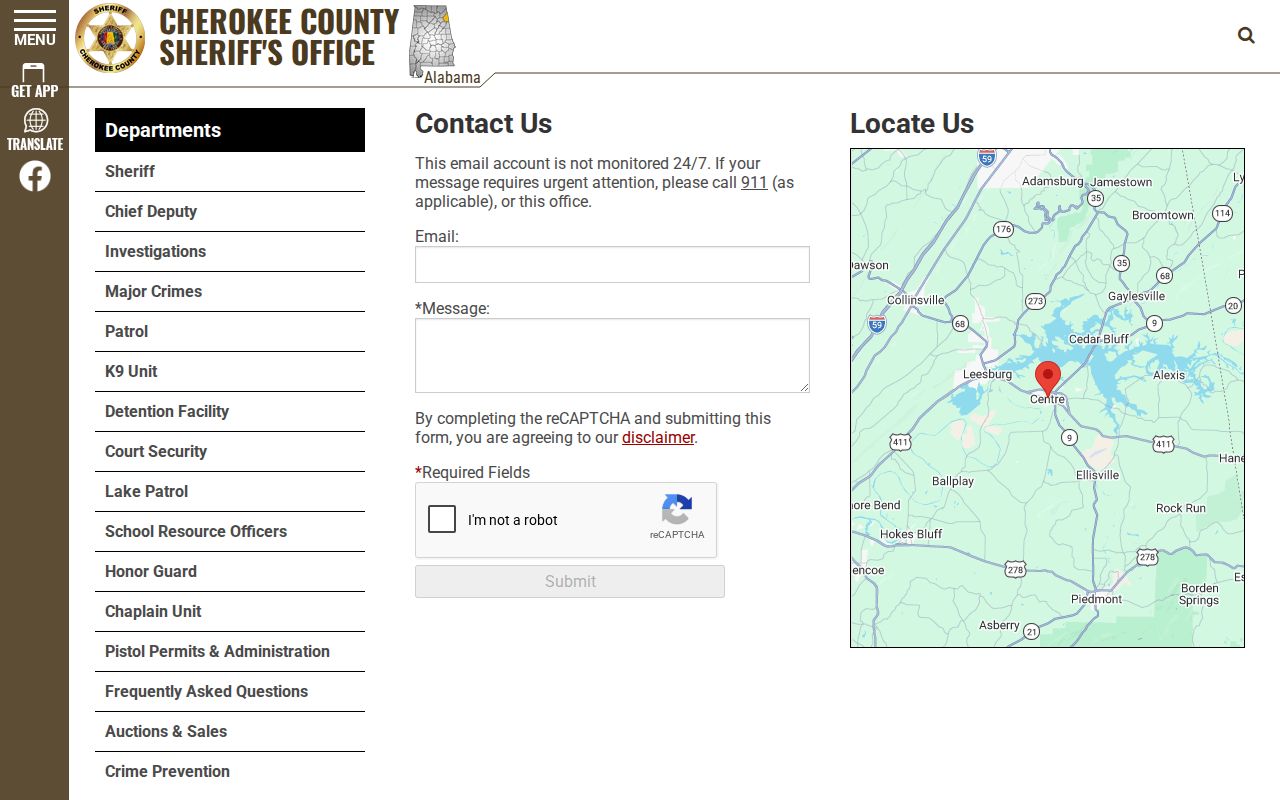
Sheriff contact details are useful for reports and custody facts, but the filed charge and disposition belong to the court record path.
State and Custody Alternatives
Statewide and federal tools answer different questions. ADOC inmate search is for people currently incarcerated in Alabama Department of Corrections custody, not pretrial Cherokee County jail booking. BOP inmate locator is for federal custody. VINE gives custody information and release, transfer, or escape notification, and Cherokee's detention page lists VINE at 1-877-846-3425. None of those tools replaces a Cherokee County court charge record.
The sheriff website also has an app page with download links, but the captured official text did not prove an app-only inmate or warrant feature. Do not assume the app has a complete charge search. Use it only as a sheriff information channel unless the app listing confirms a specific function.
Background Check Considerations
Arrest records and court charges can be misunderstood when they are used outside their court context. A booking entry may list a charge that changes. A court charge may be dismissed. A conviction may be expunged or sealed later. Anyone using Cherokee County arrest records or court charges for employment, housing, credit, insurance, or another regulated purpose must follow the law that applies to that use and verify the record with the official source.
Important: Casual arrest and charge lookups are not a substitute for legally compliant background screening.
Restricted Charge Records in Cherokee County
Restricted charge records include juvenile records, sealed files, expunged matters, sensitive personal identifiers, and records limited by statute or court order. The Circuit Clerk's records request form is limited to Cherokee County Circuit and District Court records and does not supply federal, state, municipal, other-county, or out-of-state records. If a charge was filed in Centre Municipal Court or Cedar Bluff Municipal Court, the county warrant page says municipal misdemeanor matters usually stay with that municipal court unless a felony or extraordinary circumstance is present.
Sheriff incident reports are obtained from the Sheriff's Office during normal business hours according to the FAQ. Court charge records are obtained through Alacourt or the Circuit Clerk. Keeping those channels separate is the most reliable way to avoid mixing an arrest-only record with a final court result.
Note: A missing online charge can mean no court case has been filed yet, the matter is municipal, or the record is restricted.